
Service
Whole House Battery Backup
Works whether or not you already have solar. Keeps power on during a shutoff, and stores cheap power for expensive hours.
Two problems, one piece of equipment
The first is obvious if you live in Contra Costa County: the power goes out. Public Safety Power Shutoffs, storm outages, and rolling blackouts all end the same way — no lights, no refrigeration, no well pump, and no way to work from home.
The second is less obvious and costs more money. In April 2023 California moved to NEM 3.0, and the credit you earn for exporting solar to the grid dropped sharply. Sending your midday production to PG&E now earns a fraction of what it once did.
That changes the math on solar completely. Under the old rules, exporting was nearly as good as using your own power. Under NEM 3.0, power you export is worth far less than power you keep — which means the value has moved from the panels to what you do with what they make.
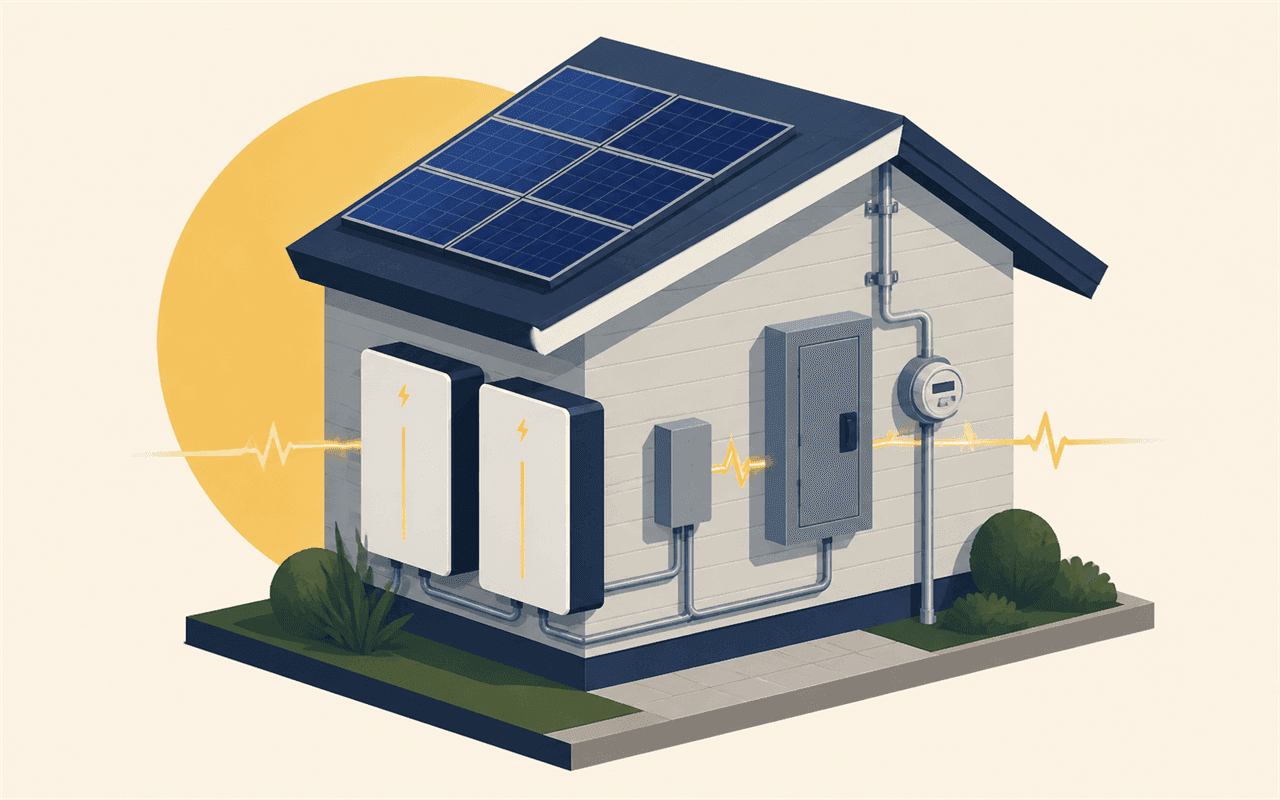
How storage actually pays under NEM 3.0
A battery lets you hold your midday production and spend it during the late-afternoon and evening peak, when PG&E's time-of-use rates are at their highest. Instead of selling low and buying high, you use your own power at the moment it is worth the most.
The backup function runs on the same hardware. When the grid drops, the system carries your house — or a chosen set of critical circuits — without you doing anything. Which loads stay up is a design decision we make with you, based on what actually matters in your household and what the system can realistically carry.
Storage works on houses that have no solar at all. If you are not ready for panels, a battery can still shift your usage off peak rates and cover outages.
How it goes
What to expect
Load and outage planning
We work out what has to stay powered during an outage — refrigeration, well pump, medical equipment, a home office — and size around that rather than around a brochure.
Placement walkthrough
Batteries can go in a garage, on an exterior wall, or out of sight. We find a spot that meets code and does not make the side of your house ugly.
Electrical design
Backup requires separating protected loads from the rest of the service. This is electrical work first, which is the part we have done for decades.
Permit and install
Permitted with your city and installed to code, then commissioned and tested against a simulated outage before we leave.
Questions
Battery Backup FAQ
Can I add a battery to solar panels I already have?
Usually yes, though it depends on your existing inverter setup. Some systems accept storage directly; others need additional equipment to work with a battery. We check what you have before quoting.
Does a battery work if I don't have solar?
Yes. Without solar it charges from the grid during cheap off-peak hours and discharges during expensive peak hours, and it still provides outage backup. The savings are smaller than a solar-plus-storage setup, but the backup is identical.
Will it run my whole house during an outage?
That depends on capacity and what your house draws. Whole-home backup is achievable, but large intermittent loads like air conditioning, electric ranges, and well pumps drive the sizing. We are straightforward about what a given system will and will not carry.
What is NEM 3.0 and why does it matter?
It is California's current net-billing rule, effective April 2023. It pays much less for solar exported to the grid than the previous NEM 2.0 rules did. The practical result is that storing your own power is now worth considerably more than selling it.
Also from us
Related services
Custom Solar Installation
Systems designed around your roof and your actual usage — not a template pulled off a sales sheet.
Learn more →Solar Panel Repair & Replacement
Production dropped? Got a surprise true-up? We diagnose what is actually wrong instead of selling you a new system.
Learn more →Solar Panel Removal & Reinstallation
Re-roofing a house with solar on it? We take the array off, keep it safe, and put it back correctly.
Learn more →
Ready to talk about battery backup?
We look at the actual job and give you a written price — including any electrical work it needs, up front.
Monday – Friday, 9:00am – 5:00pm · We do NOT send auto texts or emails. We will only reach out to you directly about your inquiry.