
Service
EV Charger Installation
Level 2 charging, permitted and installed to code by a licensed electrical contractor.
The outlet in your garage is not going to cut it
A standard 120V household outlet — Level 1 — adds only a few miles of range per hour. For a short commute that can be survivable. For most drivers it means the car never quite catches up overnight.
Level 2 charging runs at 240V on a dedicated circuit and changes the experience entirely: you plug in when you get home and the car is full in the morning. The catch is that it is a real electrical circuit, not an appliance you unbox and hang on the wall.
It also has to be permitted and inspected, and it has to fit within your home's existing service capacity. That last part is where a lot of installs run into trouble, particularly on older Contra Costa County houses still running 100-amp service.
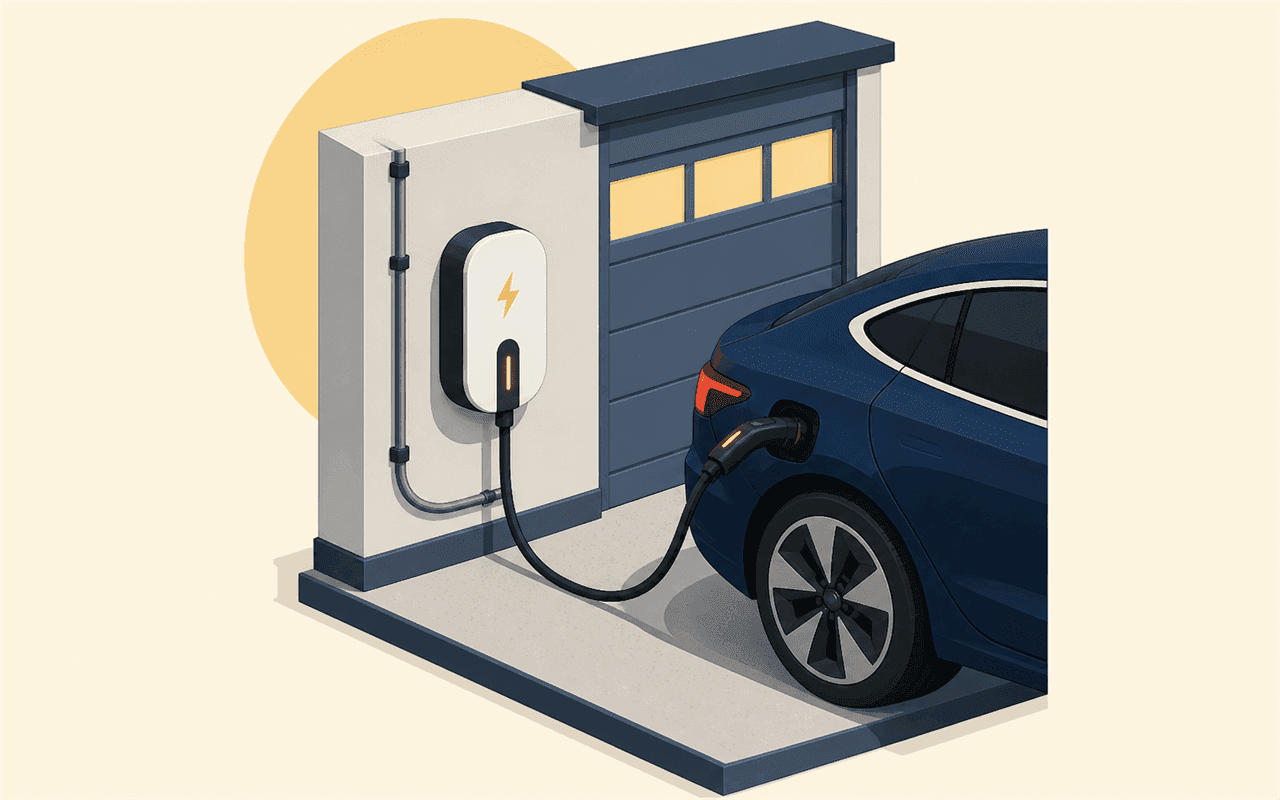
Sized to your service, permitted, and inspected
We start with a load calculation on your existing service. That determines what your panel can actually support and whether the circuit you want is achievable without upgrading the service — a question worth answering before you buy hardware.
From there it is a dedicated 240V circuit, correctly sized conductors and overcurrent protection, and a properly mounted unit. If your panel does not have capacity, we will tell you what a service upgrade involves rather than overloading what is there.
We install charging equipment you have already bought as readily as equipment we supply. If you are adding solar or storage at the same time, doing the work together generally saves a second round of trenching, conduit, and permitting.
How it goes
What to expect
Load calculation
We assess your existing panel and service capacity to confirm what can be added safely and to code.
Placement and routing
We work out where the unit goes and how the circuit gets there — the run length and route drive most of the cost.
Permit and install
Permitted with your city, then installed on a dedicated circuit sized for the charger.
Inspection and testing
We meet the inspector and verify the unit charges correctly before we leave.
Questions
EV Chargers FAQ
Do I need a permit for a home EV charger?
Yes. A Level 2 charger is a permanent 240V circuit and California jurisdictions require a permit and inspection. Unpermitted electrical work can also cause problems when you sell the house.
Can my existing panel handle a charger?
Often, but not always — especially on older 100-amp services, and especially if you already have other large electric loads. A load calculation answers it definitively, and we do that before quoting.
How fast will it charge?
That depends on the charger's amperage and what your vehicle accepts. A typical Level 2 install adds enough range overnight for essentially any normal daily driving. Your car's onboard charger is often the real limit, not the wall unit.
Can you install a charger I already bought?
Yes. Bring your own equipment and we will install it, as long as it is a listed unit appropriate for the location.
Also from us
Related services
Custom Solar Installation
Systems designed around your roof and your actual usage — not a template pulled off a sales sheet.
Learn more →Whole House Battery Backup
Storage that keeps the house running through an outage — and, under NEM 3.0, does most of the work on your bill.
Learn more →Solar Panel Repair & Replacement
Production dropped? Got a surprise true-up? We diagnose what is actually wrong instead of selling you a new system.
Learn more →
Ready to talk about ev chargers?
We look at the actual job and give you a written price — including any electrical work it needs, up front.
Monday – Friday, 9:00am – 5:00pm · We do NOT send auto texts or emails. We will only reach out to you directly about your inquiry.